

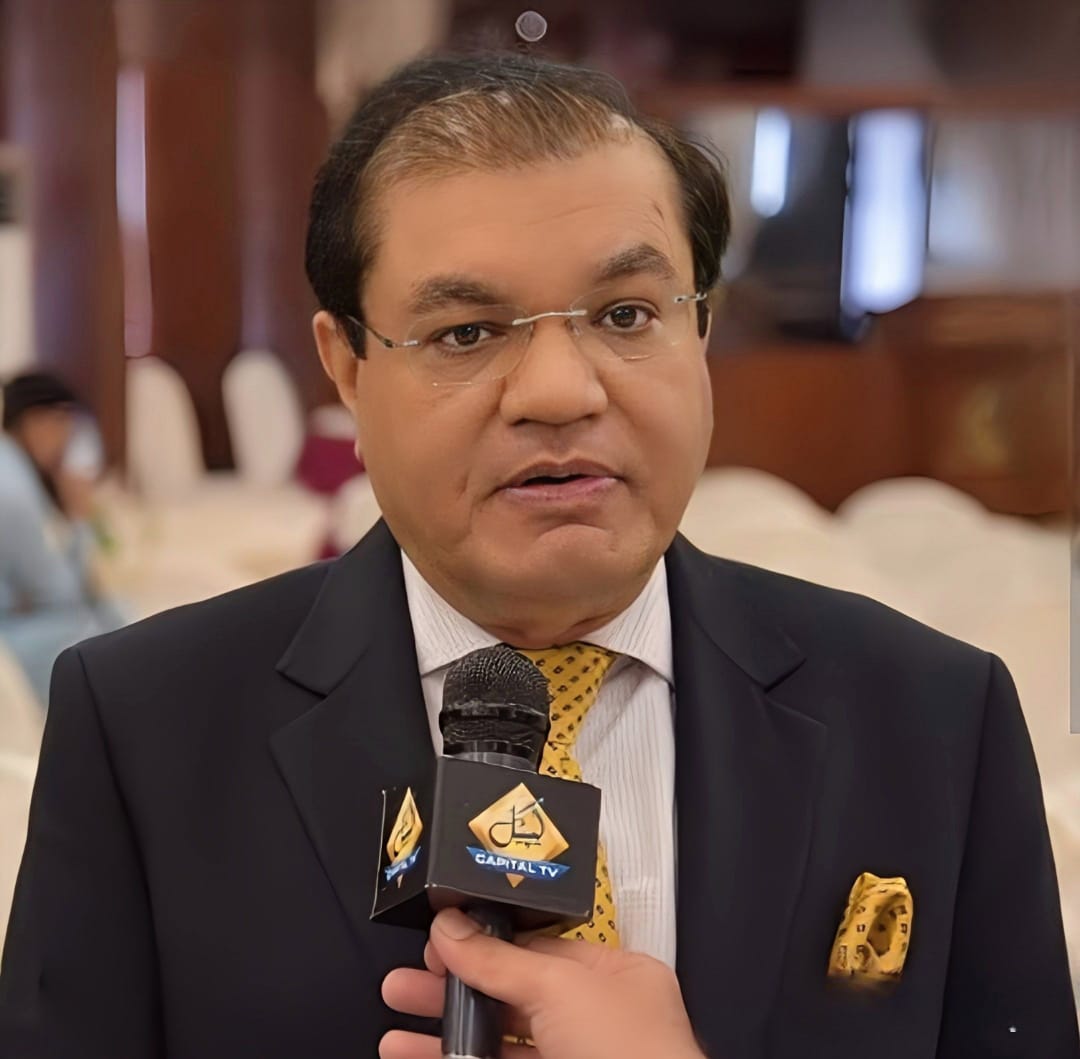
KARACHI (August 24, 2026): Mian Zahid Hussain, President Pakistan Businessmen and Intellectuals Forum and All Karachi Industrial Alliance, Chairman National Business Group Pakistan, Chairman Policy Advisory Board FPCCI, and Former Provincial Minister Information Technology, has said that Pakistan’s exports to the Gulf Cooperation Council countries increased by 2.1 percent during January-July 2026, reaching $1.944 billion compared with $1.904 billion in the corresponding period of 2025. He said that, in the context of the US-Iran war, the increase of approximately $40 million was encouraging and demonstrated the continued importance of the Gulf countries in Pakistan’s external trade.
Mian Zahid Hussain said that Pakistan’s exports to the United Arab Emirates increased by 5.9 percent, from $1.209 billion to $1.280 billion. The increase of $71.1 million in exports to the UAE was equivalent to approximately 178 percent of the total net increase of $40 million in Pakistan’s exports to the GCC. He stated that the UAE accounted for 65.9 percent of Pakistan’s total exports to the GCC, while Saudi Arabia contributed another 20.6 percent. Together, the two major markets absorbed 86.5 percent of Pakistan’s total exports to the region, compared with approximately 84.3 percent during the corresponding period last year. He added that the UAE and Saudi Arabia provided Pakistan with a strong commercial foundation in the Gulf. While strengthening trade relations with these two important markets, Pakistan must also give serious attention to Oman, Qatar, Bahrain and Kuwait.
Mian Zahid Hussain said that exports to Saudi Arabia increased modestly by 1.4 percent to $401.1 million. Kuwait recorded the highest percentage growth among GCC destinations, with exports rising by 14.7 percent from $62.7 million to $71.9 million. Although Kuwait represented only 3.7 percent of Pakistan’s total GCC exports, its performance demonstrated that significant opportunities for additional exports existed in smaller Gulf markets through organised commercial engagement and the identification of new buyers. Mian Zahid Hussain expressed concern over the slight decline in exports to Oman, Qatar and Bahrain. He said that Pakistan’s total exports to the four GCC countries other than Saudi Arabia and the UAE declined by approximately 4.5 percent. He said these figures proved that, contrary to the general perception that Pakistan’s relations with the UAE had declined, the overall increase in Pakistan’s GCC exports was primarily driven by the United Arab Emirates. Therefore, despite the UAE’s politically cold posture, Pakistan should continue promoting an atmosphere of warmth, brotherhood and cooperation with the UAE.
Mian Zahid Hussain said that Pakistan’s monthly export performance also witnessed considerable volatility. Exports reached a seven-month peak of $323.2 million in February 2026 but subsequently declined to $298 million in March, $241 million in April and $240.7 million in May. He said that a recovery began in June, when exports increased to $259.5 million, followed by a further increase to $290.3 million in July. July exports were 11.9 percent higher than June and 4.7 percent above July 2025. However, they remained approximately 10.2 percent below the February peak. Therefore, the recent recovery was positive, but export growth would have to continue for several months to make it sustainable.
Mian Zahid Hussain appreciated the efforts of Prime Minister Mian Muhammad Shehbaz Sharif and Field Marshal Syed Asim Munir to strengthen Pakistan’s diplomatic and economic relations with the Gulf countries. He said that the defence cooperation agreement with Saudi Arabia in the first phase and Türkiye’s inclusion in the agreement during the second phase had significantly enhanced Pakistan’s importance at the international level. Kuwait, Egypt and Bangladesh were now also expressing interest in joining the said defence agreement. He further added that these defence relations should now be translated into concrete export orders, stronger business-to-business linkages and improved market access for Pakistani products.
Mian Zahid Hussain called for a two-tier export strategy for the GCC. At the first level, Pakistan’s commercial presence in the UAE and Saudi Arabia should be further strengthened. At the second level, separate export-recovery plans should be developed for Oman, Qatar, Bahrain and Kuwait. Kuwait should be treated as an emerging market and prioritised through targeted trade delegations, buyer-seller meetings and the promotion of specific Pakistani products. He further recommended an immediate product-level assessment of exports under the relevant HS codes to identify which commodities were driving growth in the UAE and Kuwait and which products were responsible for the decline in exports to Oman, Qatar, Bahrain and Kuwait.
Mian Zahid Hussain said that Pakistan’s export performance in the GCC remained resilient despite the uncertainty due to the US-Iran war, but it continued to depend heavily on two markets. Sustainable growth would require converting the June-July recovery into consistent export expansion and increasing Pakistan’s commercial presence across all six Gulf markets.

